
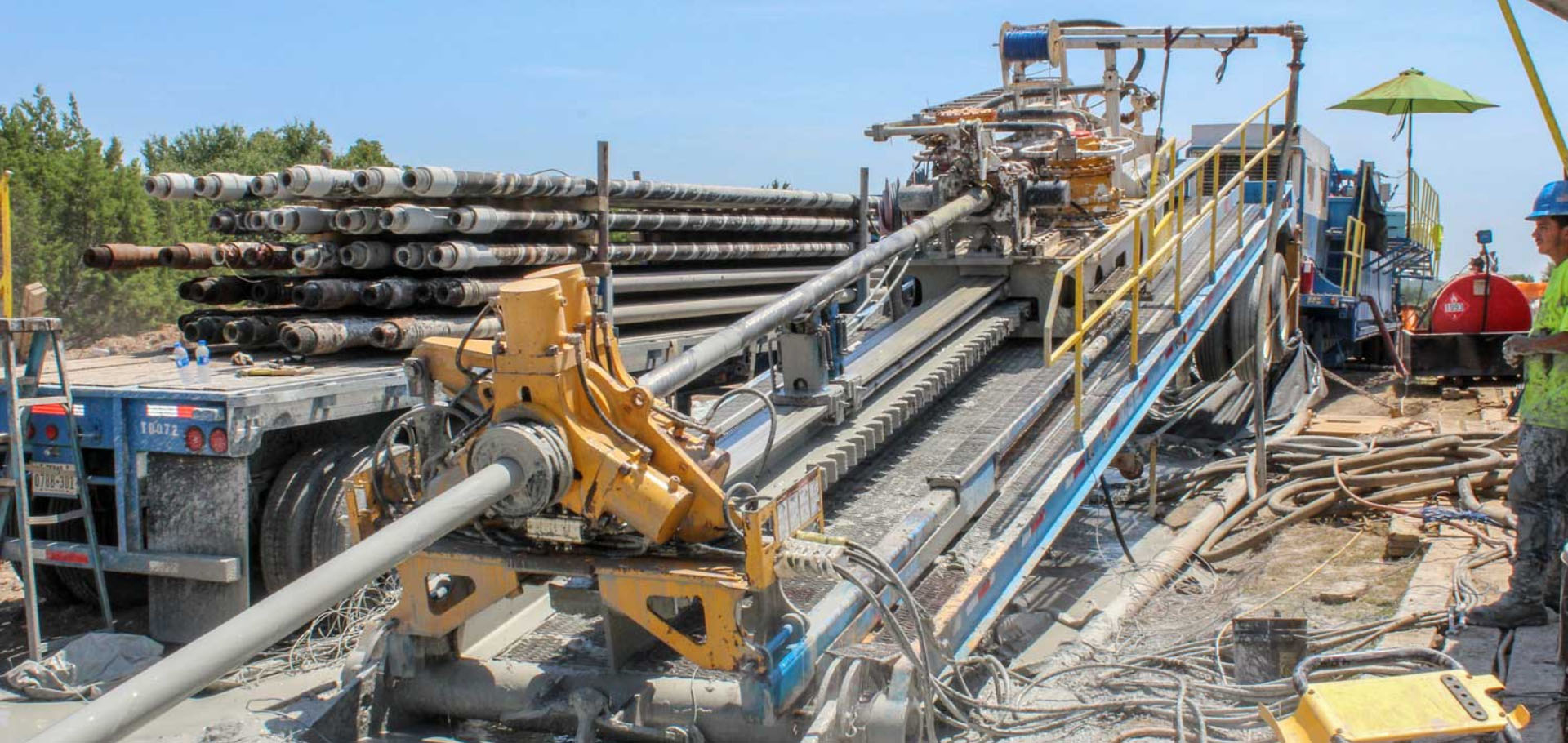
Huxted Trenchless provides precision microtunneling services for critical utility installations requiring accurate line and grade, groundwater control, settlement mitigation and minimal surface disruption.
With experience completing drives in excess of 2,000 feet, curves and pipe diameters ranging from 24 inches to over 117 inches, our team is equipped to take on complex microtunneling projects across a wide range of ground conditions, alignments and site constraints.

What microtunneling is and is not
Microtunneling is a mechanized, remotely operated trenchless construction method used to install pipe with a high degree of accuracy. While microtunneling is often associated with smaller-diameter installations, it is not defined solely by size. It is defined by the use of a guided tunnel boring machine, pipe jacking operations and a closed-face excavation system designed to maintain face stability and control groundwater.
Microtunnel boring machines are typically laser-guided but may also use gyroscopic guidance, theodolites, prisms and other survey systems depending on the alignment, drive length and project requirements. These systems allow the machine to be continuously monitored and steered to maintain the specified horizontal and vertical alignment.
The tunnel boring machine provides earth pressure balance and hydrostatic counterbalance, allowing excavation to proceed in varying geotechnical conditions while reducing the risk of surface heave, settlement or loss of ground. Because the system is designed to operate below groundwater, dewatering is often reduced or eliminated, which can be especially important in environmentally sensitive areas, urban corridors and unstable ground.
Microtunneling is a pipe jacking operation. The machine and product pipe are advanced from a launch shaft using hydraulic jacks, while excavated material is removed through a slurry or spoil removal system. The process is remotely operated from the surface, limiting man-entry requirements and improving safety in comparison to conventional tunneling methods.

Utilities we install:
- Sanitary sewers
- Gravity sewer systems
- Water lines
- Storm drains
- Electrical conduits
- Oil, gas and petroleum pipelines
- Industrial and process piping
Our in-house expertise:
- Underwater machine recovery for intakes and outfalls
- Curved microtunnel drives
- Environmental and wetland crossings
- Long drives in excess of 2,000 feet
- Pipe diameters from 24 inches to over 117 inches
- Marine and river crossings
- Railroad and highway crossings
- Sensitive grades and shallow cover
- Microtunneling in rock and mixed-face conditions
- Complex launch and retrieval conditions
- Groundwater-controlled installations
How microtunneling addresses complex construction challenges
Intakes and outfalls

Microtunneling is well suited for intake and outfall construction because these installations frequently terminate in underwater or saturated environments. Closed-face microtunnel boring machines provide hydrostatic counterbalance during excavation and standby conditions, reducing the risk of flooding and limiting the need for costly cofferdams or intrusive recovery structures.
Curved drives
Curved microtunnel drives allow pipelines to be installed around existing infrastructure, utilities, bridge foundations, manholes, property constraints and right-of-way limitations. Using advanced guidance systems, including gyros, prisms and survey instruments, the machine location can be monitored throughout the drive and steered along the designed vertical, horizontal or compound curve.
Environmental crossings
Microtunneling allows pipelines to be installed beneath wetlands, streams, rivers, marshes, protected habitats, reservoirs and other environmentally sensitive areas with minimal surface disturbance. By limiting excavation to launch and receiving shafts, the method helps reduce impacts to natural resources, public access, traffic and surrounding communities.
Long drives
Longer microtunnel drives can reduce the number of shafts required, minimize surface disruption and allow utilities to cross larger waterways, transportation corridors or developed areas. Long-drive planning requires careful evaluation of jacking forces, pipe design, lubrication, guidance, ground conditions, slurry separation and machine performance.
Marine and river crossings
Microtunneling provides a controlled trenchless approach for installing utilities beneath rivers, creeks, bays and other marine environments. Closed-face excavation and hydrostatic balance are especially important in saturated soils and high groundwater conditions where maintaining face stability is essential.
Railroad and highway crossings
Railroad, highway and interstate crossings often require trenchless methods that can maintain surface stability and avoid disruption to active transportation corridors. Microtunneling provides controlled excavation, accurate alignment and reduced settlement risk, making it a preferred approach for critical crossings where interruption is not acceptable.
Sensitive grades
Gravity utility systems require precise elevation control to function as designed. Microtunneling provides the line and grade accuracy needed for installations where small deviations can affect flow, capacity, maintenance and long-term performance.
Shallow cover
Shallow-cover installations require careful evaluation of ground stability, surface loading, settlement tolerance and machine operation. Microtunneling can be used in these conditions when proper design, planning and controls are in place to maintain ground support and minimize surface movement.
Microtunneling in rock
Rock and mixed-face conditions require specialized planning, tooling and machine selection. Huxted’s experience in varying geotechnical environments allows our team to evaluate cutterhead configuration, production expectations, wear, jacking forces and recovery strategies before work begins.